The Achilles Heel of Cultural Hegemony
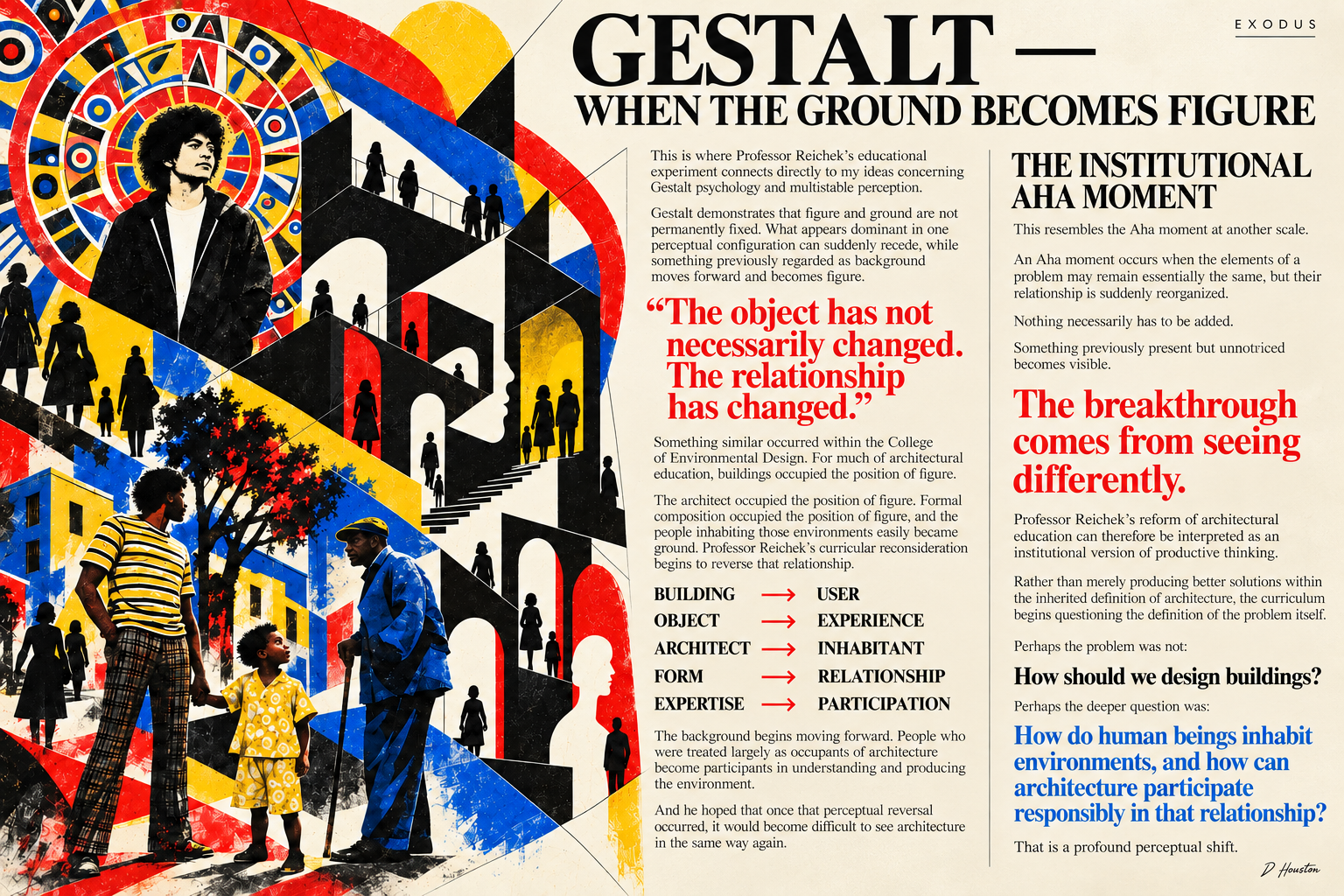
GESTALT — WHEN THE GROUND BECOMES FIGURE
2
THE ACHILLES HEEL OF CULTURAL HEGEMONY
This brings us back to what I call the Achilles heel of cultural hegemony: creative insight.
Hegemony depends upon maintaining certain relationships as though they were natural. Figure and ground appear fixed. Certain forms of knowledge remain central. Others remain peripheral. Certain voices are authoritative. Others become background.
But this arrangement depends on people continuing to perceive reality through the inherited framework.
Professor Reichek recognized that the framework itself could be reorganized, and other possibility would appear.
Hegemony attempts to stabilize perception. Creative insight destabilizes it.
Still, the significance of Professor Reichek's idea extends beyond curriculum reform. CED helped transmit Modern architectural culture, so it also needed people capable of questioning what that culture had become.
CED reproduces hegemony. But CED also needed individuals capable of perceiving its contradictions. Once those contradictions become visible, CED becomes a site of reconstruction.
EXODUS BECOMES A CYCLE
This changes the structure of Exodus. It is no longer a simple linear journey:
EXODUS → MIGRATION → INSTITUTIONALIZATION → HEGEMONY
A second movement becomes possible:
HEGEMONY → CONTRADICTION → PERCEPTION → AHA → SELF-CRITIQUE → RECONSTRUCTION
And reconstruction inevitably produces new institutions.
This was important because every reform can eventually become established. Every innovation can become convention. Every revolutionary idea can become curriculum. Every curriculum can eventually become orthodoxy.
The challenge was not simply to replace one architectural ideology with another. The deeper challenge was to create an institution capable of continually questioning what they have come to regard as natural.
Professor Reichek was not changing what architecture students were taught. He was creating the conditions where students could reconsider what architecture was for, whom it served, and whose experience counted as architectural knowledge.
In that sense, Professor Reichek's curricular reform represents something larger than another chapter in Modernism's migration. It marked the moment when CED began to look back at the consequences of that migration — and recognized something it had allowed to recede into the background.
The human being becomes figure again.
This provides my Gestalt/Aha ideas a direct architectural purpose: multistable perception becomes not merely a psychological phenomenon, but a model for institutional change.