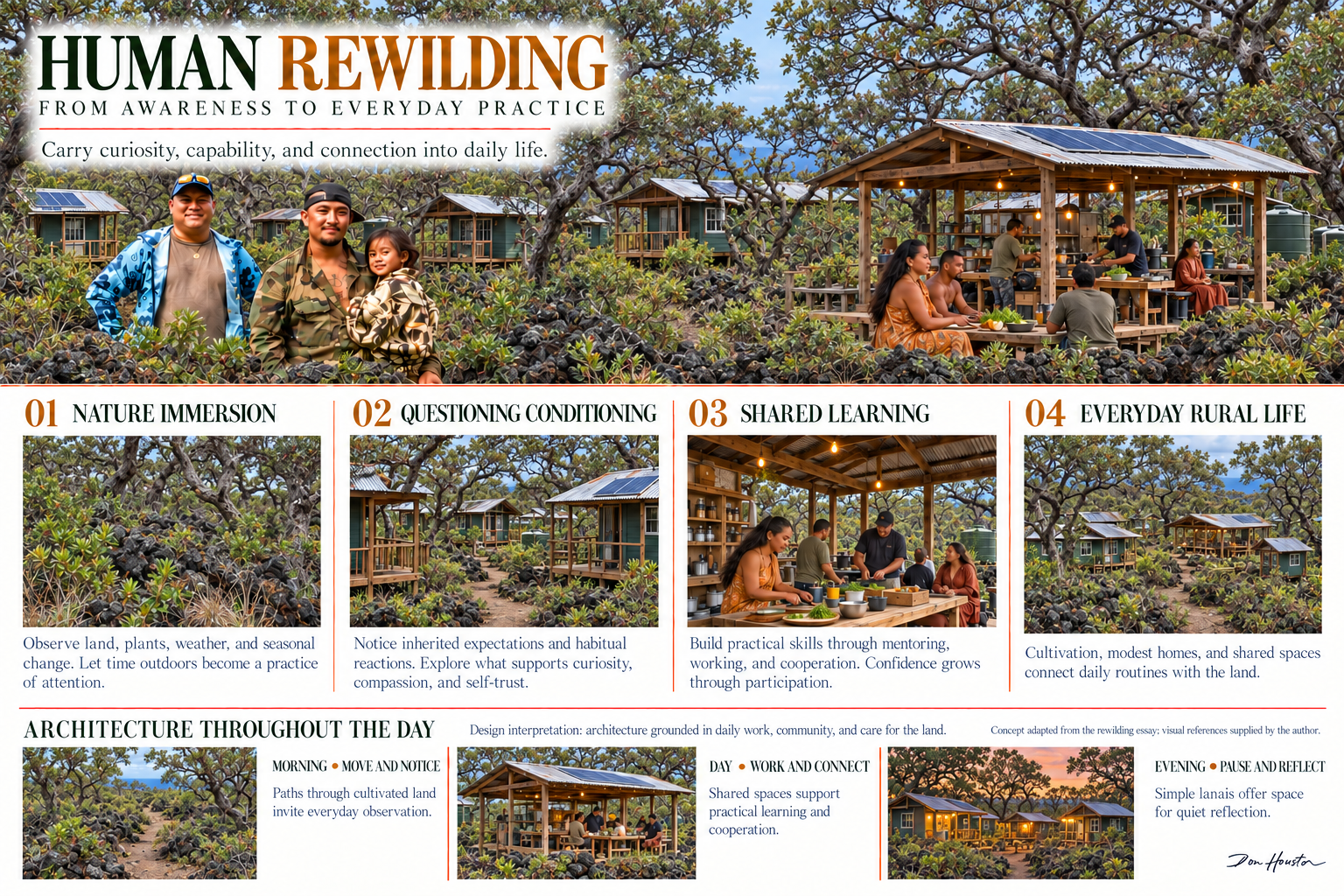
"Cultural Hegemony robs us of our natural birthright, and rewilding, to whatever extent we pursue it, helps us regain the passion, adventure, curiosity, and abundant joy that is natural."
Fresh from completing my capstone projects and buoyed by newfound confidence, I felt compelled to act. Driven by an intuition I couldn't explain, I brought my wife and newborn to the stark 1907 black lava flow at the southernmost edge of the Big Island—a decision that, on the surface, made little sense.
I tried to rationalize my actions, telling myself that I needed land to explore Christopher Alexander’s vision and to build a home shaped by the principles of A Pattern Language.
Yet, as I immersed myself in A Pattern Language, I discovered something remarkable: the methodology feels almost alive, as though it responds to your intentions and adapts to your evolving vision.
Eventually, I came to see that my seemingly odd choice was rooted in a broader context: the 1976 UN Conference on Human Settlements, which introduced site-and-service projects as innovative solutions for developing nations.
This concept returned minimalist design to its social origins, now focused on uplifting impoverished communities rather than industrial workers. In reflecting honestly, I realized that my understanding was theoretical—I had never fully experienced the realities of living within a minimalist site-and-service framework.
My involvement in developing the CED Habitat Manifesto (1976) was, in fact, the true source of my call to venture into the wild.