Piercing Cultural Hegemony
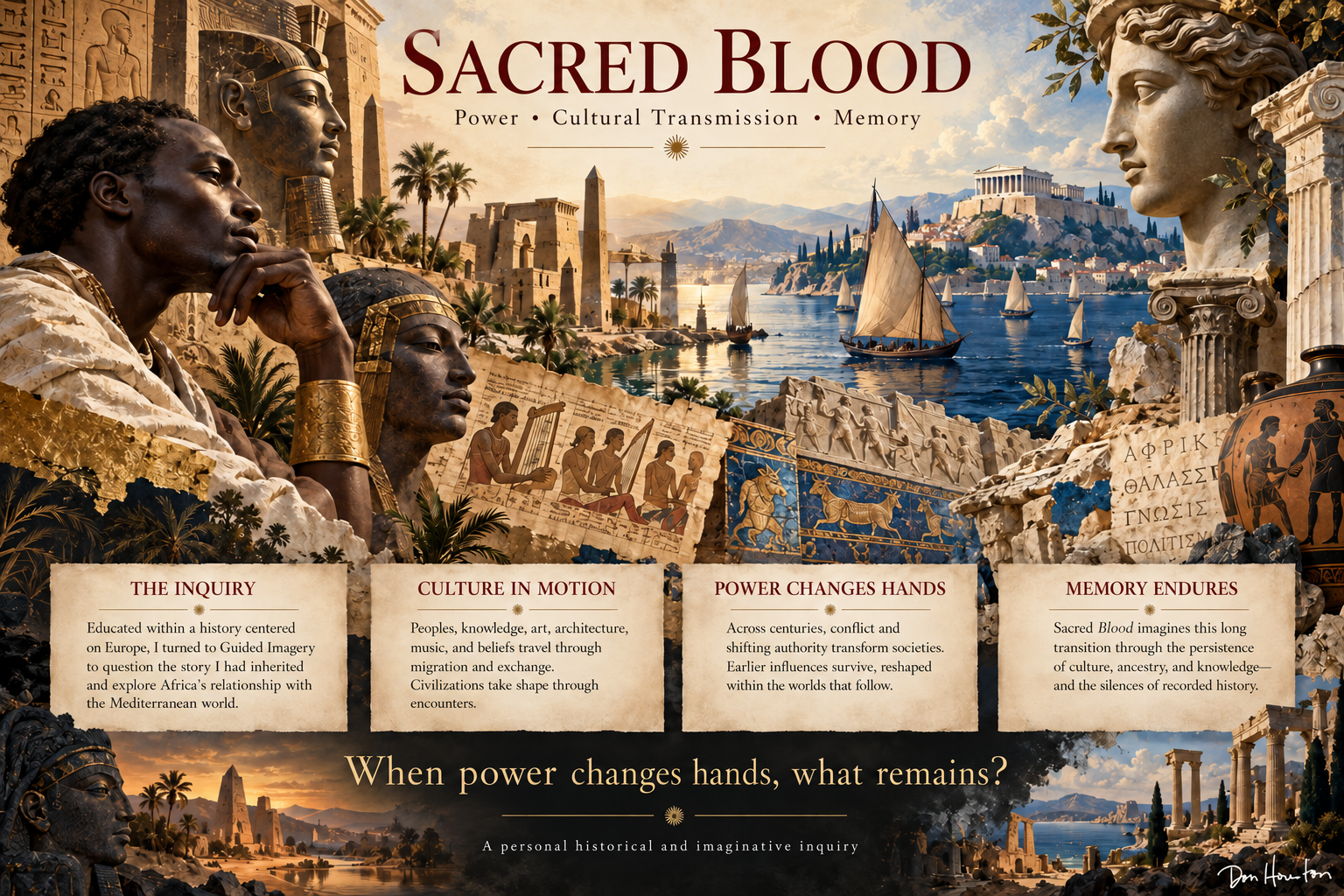
Despite being educated in an environment that largely centered European history, I remained committed to questioning the boundaries of the story I had been given. Guided Imagery helped me focus that inquiry, giving me the persistence to look beyond conventional narratives and explore Africa’s profound relationship to the emergence of Mediterranean and Western civilization.
My investigation led me to consider the movement of African peoples, knowledge, and cultural traditions into Greece and the wider Mediterranean world. I became particularly interested in the possibility that exchanges involving Africa contributed to developments in art, architecture, science, music, urbanism, religion, and systems of defense. Rather than seeing Western civilization as emerging in isolation, I began to understand it as the product of encounters among African, Mediterranean, Near Eastern, and European peoples.
From this perspective, cultural transformation was not a single event. It unfolded across centuries of migration, exchange, conflict, assimilation, and changing political power. By the time of the Trojan War, the balance of power within the Mediterranean had shifted significantly, even as earlier cultural influences continued to survive within the civilizations that followed.
Sacred Blood grew from my attempt to imagine and investigate that long transition.
It is not simply a story about who conquered whom. It is a story about what happens when power changes hands but culture, memory, knowledge, and ancestry remain — sometimes visible, sometimes transformed, and sometimes hidden beneath the history written by the victors and those who came afterward.