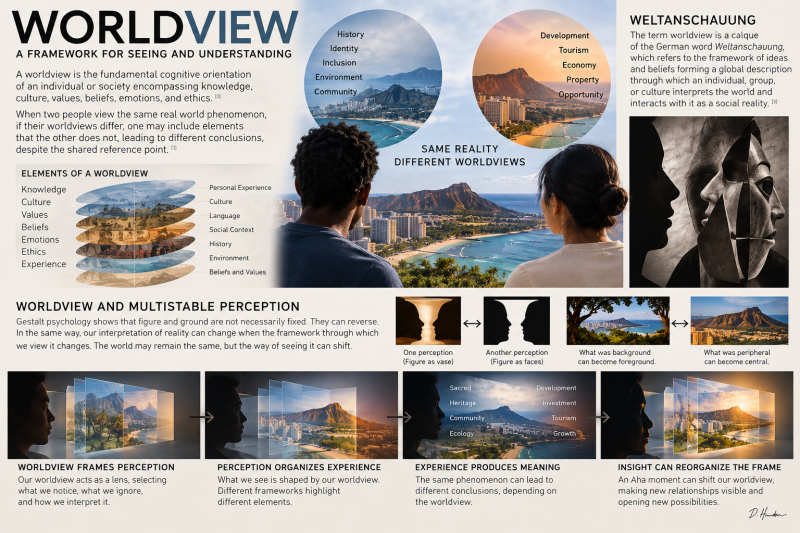
A decade before my transformative Aha moment, I was swept into a way of life shaped by the rebellious spirit of the 1960s counterculture. Alongside a group of adventurous young people, I wandered the valleys, hills, and streets of Honolulu, where family bonds were fluid, and the community seemed to pulse with a kind of tribal energy.
Gas was cheap, America still radiated possibility, and we moved freely through a landscape shaped by privileges we scarcely recognized then. That way of life disappeared more quickly than I expected, but Hawaiʻi had already left its mark on me. Without fully understanding what had happened, I had been baptized as a son of the islands.
Hawaiʻi also gave me something practical. I gained valuable experience as a construction estimator, developing skills that would later help me enter the demanding professional world of a major architectural firm.
When I returned to the mainland, I joined Kaplan/McLaughlin/Diaz Architects. Over the next six years, I steadily advanced through the firm, eventually serving as a project manager and contract administrator. I was entrusted with increasingly significant projects, each one sharpening my technical knowledge, judgment, and leadership.
Then came Alamo Square—my first project as both developer and owner. Completing it changed something in me.
The weight of cultural expectations—and my persistent need to prove myself as a Black person—began to loosen its hold on me.
My Aha moment did not arrive as an intellectual conclusion. It came as a realization that the path I had been following no longer defined the limits of what my life could become.
In its place came another force: a pull toward the poetic beauty of Hawaiʻi and toward the life I had once experienced there.
I cannot fully describe the sound that awakened that realization, but I can still feel its resonance. It seemed to come from somewhere beyond conscious thought—familiar, distant, and insistent.
Like Buck in Jack London’s The Call of the Wild, I heard a call that altered my perception of the world.
It was a call back to Hawaiʻi.
What began years earlier as a youthful encounter with the islands revealed itself as something deeper. Hawaiʻi was no longer simply a place from my past. It became the direction of my future.
The Aha moment allowed me to recognize what had been there all along: