The Achilles Heel of Cultural Hegemony
The Call of the Wild
Wave Form
https://commons.wikimedia.org/wiki/File:Caro_DreamCity_1996.jpg
https://en.wikipedia.org/wiki/File:HenryMoore_RecliningFigure_1951.jpg
Professor Peter Voulkos helped revolutionize our understanding of materiality by puncturing and opening his ceramic sculptures, making interior and exterior space part of the same experience.
His fearless challenge to traditional boundaries resonates with the organic openings of Henry Moore and with the radical experiments of Dada and Kurt Schwitters, where established definitions of art and material were continually broken apart and reconstructed.
This insight triggered another Aha moment.
Following this thread led me back to Naum Gabo and his experiments with kinetic art, where movement itself becomes the material. His discovery carries an unexpected connection to the gift Pele revealed to me on the lava fields: both emerged through encounters with dynamic forces rather than static form.


In Gabo’s Standing Wave (1919–20), a vibrating element moves at a frequency that produces the visual impression of a continuous, three-dimensional form. What appears to be a solid object is actually generated through movement. The form exists because of vibration.
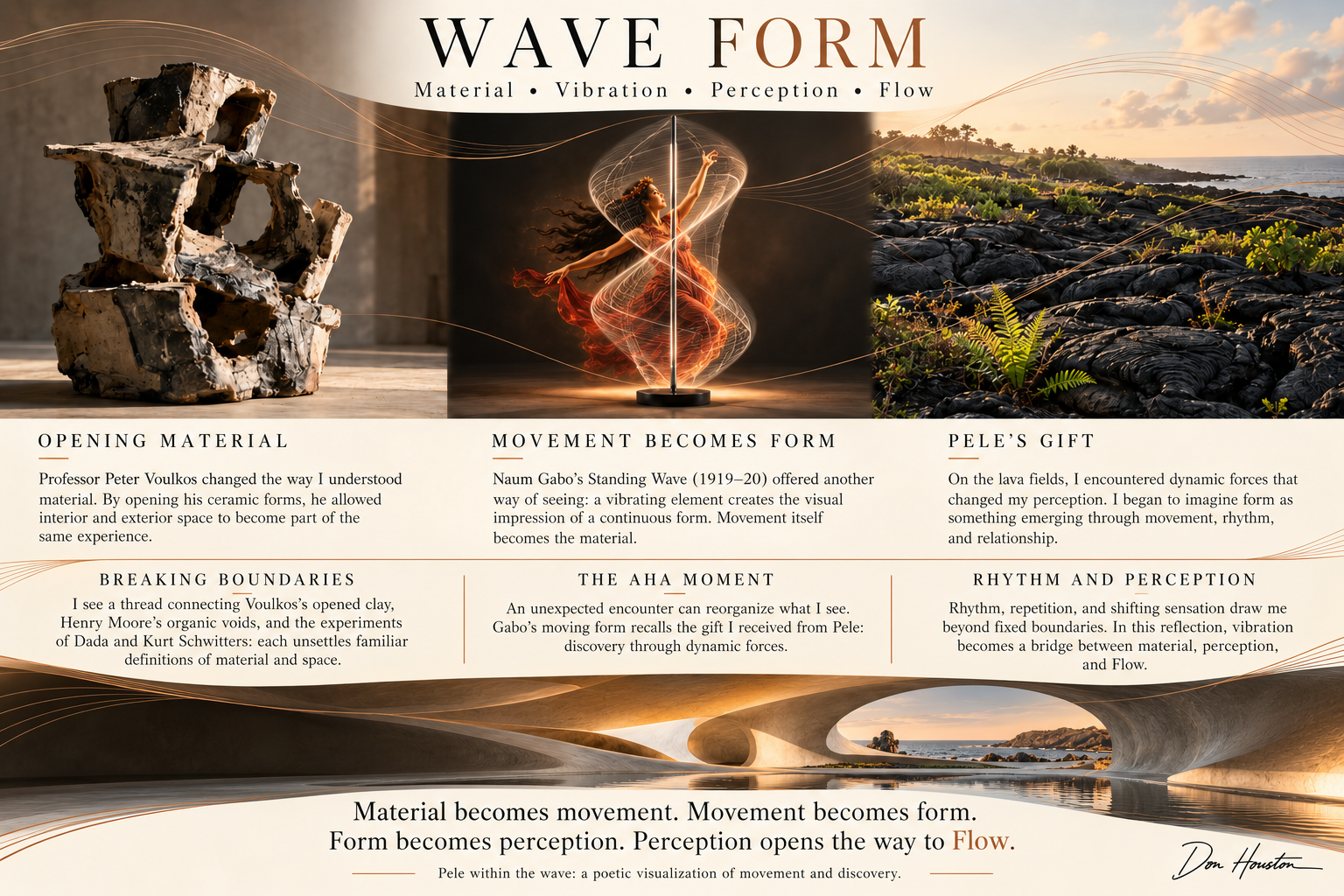
Reflecting on Pele’s dance during the rewilding event, I began to recognize a parallel way of seeing reality. Instead of understanding matter as something permanently fixed, I began to imagine it as pulses of kinetic energy — forces moving, interacting, and temporarily giving form to what we experience as matter and time.
Many paths seem to converge on this realization, but Gabo’s Standing Wave distills it into a remarkably simple image: vibration creating the illusion of form.
That idea also connects with ancient traditions in which rhythm, vibration, repetition, and altered perception carried profound or sacred meaning — experiences I have come to associate with aporphine’s influence.