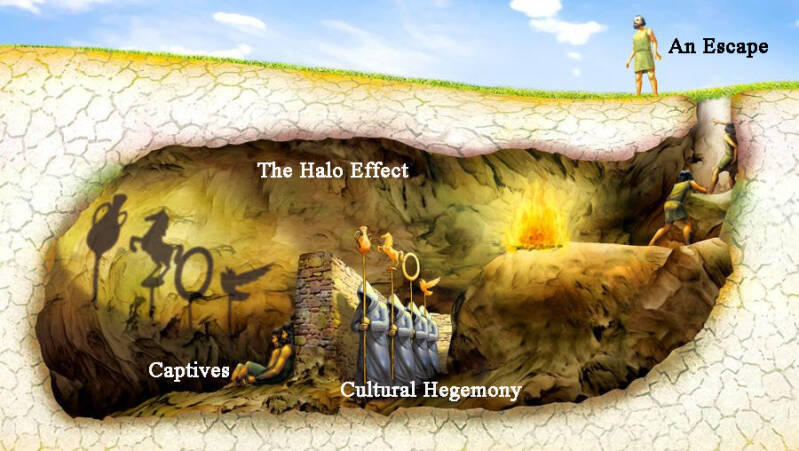
The construction of democratic space is essential to avoid a false narrative in which citizens, presumed to be “free,” are captives in an environmental illusion similar to Plato's cave.
Plato's Cave
Democratic space completely changes the narration of space fostered by traditionalist regression, characterized by the architect who knows best, self-made entrepreneurs, and generational wealth, indifferent to public interest but needing symbolic, protective skyscraper fortresses.
Like democracy, democratic space bets on the possibilities of transformation even when the assumptions of environmental design are under strain in times of crisis. It calls for a belief in the 'constructability' of a 'life in common,' symbolized by spatial systems designed with structural reciprocity, in which the forces "lean" on each other yet remain self-supporting.
These spaces embody a 'civic spirit,' fostering a shared sense of belonging and agreement on principles like freedom, work, and sexual equality, which are nourished by public discourse and reinforce social cohesion.
From this perspective, democratic space is the spatial narration of a people as they build an identity. A presentation of themselves in public where legitimacy and validation of architectural form is derived from a People demonstrating their ability to project their democratic ideals into the environment.
Emotional involvement must animate the narrative and mobilize a reciprocal process between identity and representation that produces a “People,” more on this later.
MOLM Structure of Reciprocity 2010 Noted Yellow DH