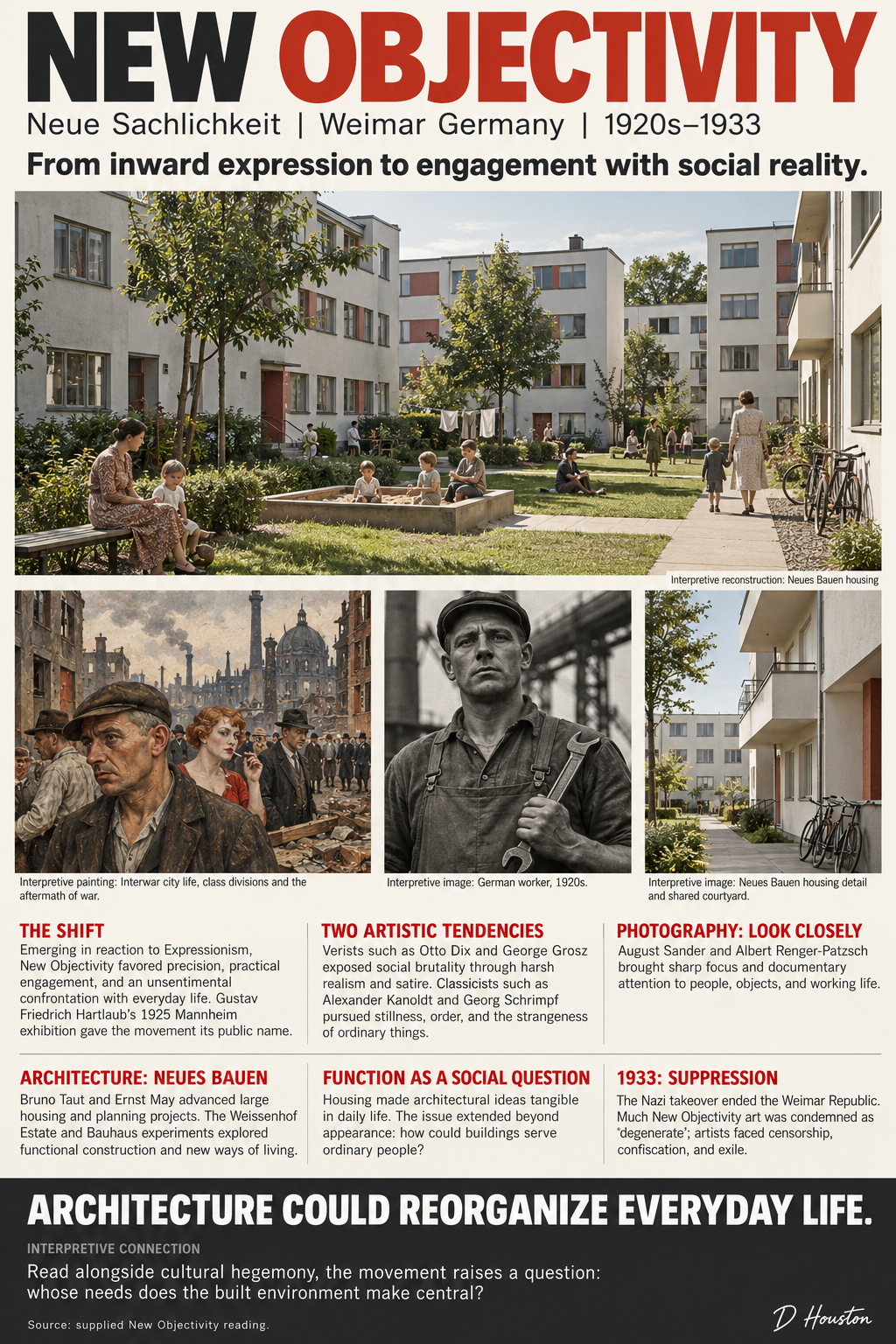
In the aftermath of World War I, art that promoted socialism and cultural renewal confronted a Germany devastated by scarcity, political upheaval, and loss. Military defeat and the collapse of imperial ambitions left the nation fractured and demoralized.
The old order had failed, and the question was no longer how Germany should rebuild, but what kind of society should replace it.
Before the optimism of the 1920s disappeared, a powerful new force emerged: New Objectivity — Neue Sachlichkeit — also known as New Sobriety.
The movement swept across painting, photography, theater, design, and architecture, rejecting sentimentality and romantic idealism in favor of a direct engagement with modern social reality. But nowhere were its consequences more tangible than in architecture.
Germany embarked on ambitious programs to transform workers’ housing. Architecture became more than the production of individual buildings. It became an instrument for reorganizing everyday life.
Quality housing, public transportation, sanitation, electricity, sunlight, fresh air, green space, safety, and community infrastructure were no longer treated merely as privileges for the wealthy. They became part of a larger social project directed toward improving the lives of ordinary working people.
Architects, planners, artists, engineers, and public officials collaborated to turn these ideas into physical reality.
Architecture was being asked to participate in the reconstruction of society itself.