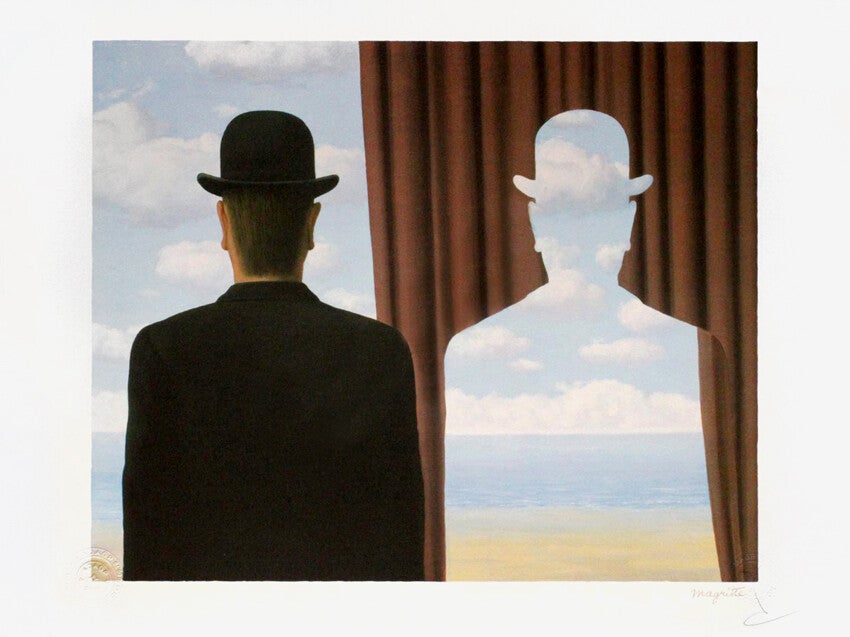
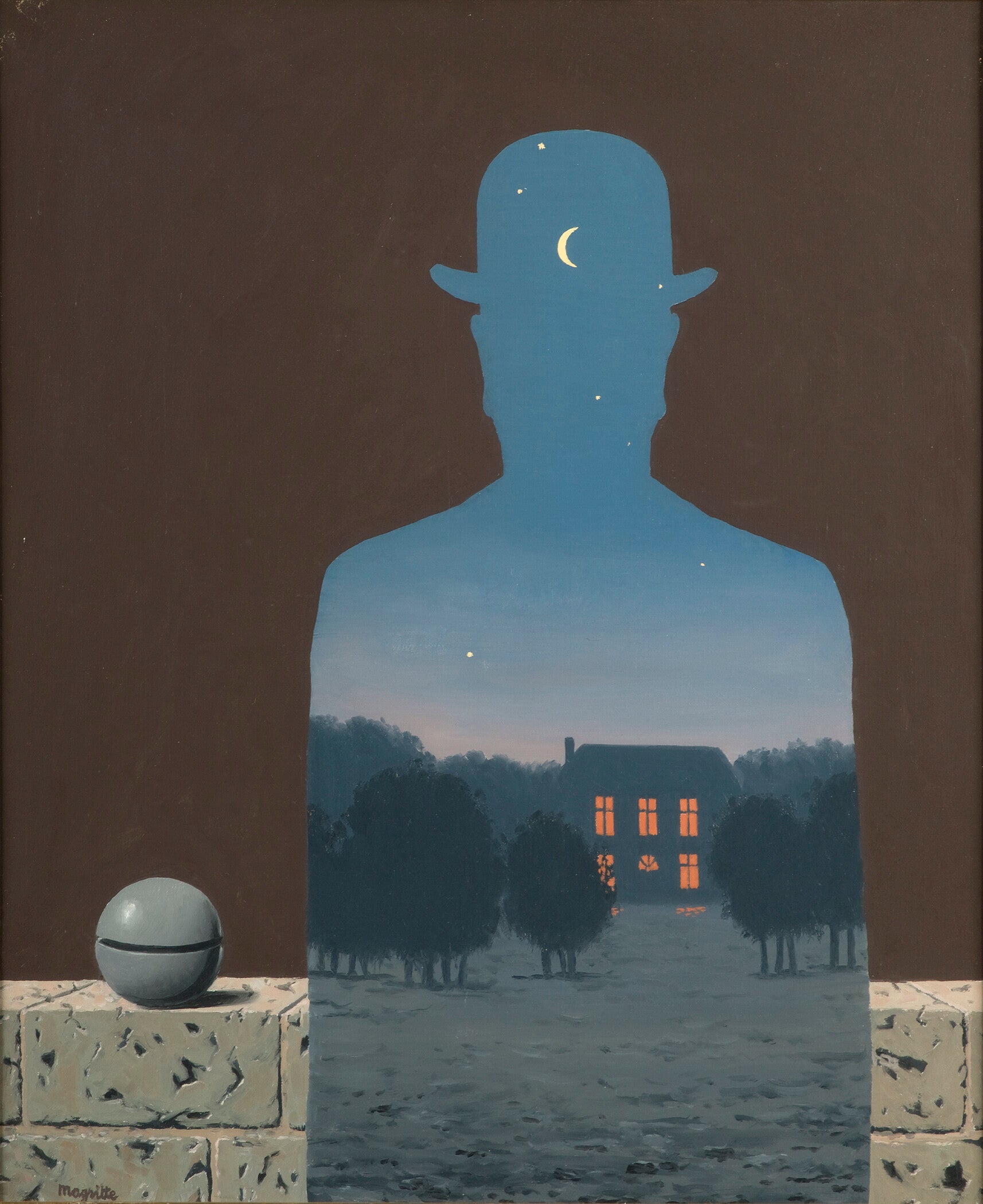
Through the lens of Guided Imagery, writing can be understood as the shadow of a thought—the trace left behind when an inner image is given outward form. Words do not reproduce thought itself; they capture its outline, making something invisible visible.
Décalcomanie Rene Magritte 1966
The Happy Donor Rene Magritte 1966
In much the same way, the writer or artist becomes a screen on which an idea is projected. At first, the image may appear only as a silhouette—a boundary, a gesture, a shape waiting to be filled with color, texture, movement, and life. From this elemental impulse—to trace what has been seen, remembered, dreamed, or imagined—we can begin to understand painting's emergence.
The silhouette therefore occupies an important place in the histories of both image-making and writing. Long before alphabetic writing, African artists transformed human beings, animals, spirits, movement, and memory into recognizable forms through contour, profile, and symbolic representation.
In ancient Egypt, this relationship between image and being acquired extraordinary spiritual significance. People were understood as possessing multiple dimensions of existence, including the Ka, often described as an important or spiritual double. Images made for tombs and temples were therefore more than decoration. They participated in a world in which representation, memory, identity, ritual, and continued existence were intimately connected.
The characteristic profile of Egyptian figures makes this relationship especially powerful. The painted figure exists simultaneously as a visible form and as the suggestion of something beyond the visible. What appears on the wall outlines a much larger reality.
Seen through Guided Imagery, the silhouette becomes a threshold.
It stands between absence and presence, darkness and light, thought and form, the invisible and the visible.